Gửi Email Cho Chúng Tôi :
info@labcompanion.cn
-

-

Yêu cầu cuộc gọi :
+86 18688888286

Dual Threats to 5G Base Stations: Internal Heat Accumulation & Extreme Ambient Temperature Fluctuations
Global large-scale 5G deployment and vertical industry integration are accelerating. Shenzhen hosts 442 5G upstream and downstream enterprises, the largest cluster worldwide, with local 5G applications covering 91 categories of national economic sectors. Despite robust industrial growth, thermal reliability defects have become a top risk for outdoor 5G infrastructure long-term operation.
Compared with 4G counterparts, 5G macro base stations adopt massive MIMO antenna arrays and GaN high-power RF amplifiers, driving a sharp surge in power consumption. Field data shows RF front-end power density of 5G devices is over 3 times higher than 4G, with local heat flux exceeding 300W/cm² and instantaneous component surface temperatures hitting 120°C — far beyond the 85°C safe operating threshold for telecom hardware. Beyond internal heat generation, outdoor deployment exposes base stations to harsh cross-climate conditions: units operate 24/7 across -40°C to +85°C, enduring cyclic thermal stress from diurnal temperature swings and seasonal climate shifts that degrade circuit boards, solder joints and waterproof seals over time.
Combined thermal overload and rapid temperature cycling trigger cascading failures. Minor issues include RF gain attenuation, signal phase distortion and unstable data throughput. Severe faults cover chip thermal throttling, solder joint fatigue cracking and partial antenna failure, ultimately causing base station outages. As a result, standardized environmental simulation testing equipment that replicates real-world outdoor thermal conditions has become mandatory for 5G R&D, validation and mass production quality control.
Founded in 2005, Lab Companion (Guangdong Hongzhan Technology) specializes in R&D and manufacturing of environmental reliability testing systems. Its TC-series rapid thermal change chambers are widely deployed in 5G RF modules, high-speed optical transceivers and semiconductor packaging worldwide. This paper analyzes how Lab Companion addresses 5G thermal reliability challenges from industrial pain points, core product capabilities, global application cases and overseas remote service frameworks.
1. Industry Pain Points: Outdated Testing Solutions Fail Updated Telecom Standards
5G overheating risks stem from fundamental architectural upgrades. Massive MIMO expands antenna channels from 8 (4G) to 64/128 for 5G, while mainstream GaN power amplifiers push AAU power consumption to 1000W-1500W. Legacy passive heat sinks and basic air cooling designed for 4G lack sufficient thermal margin, making them unable to verify structural durability under rapid thermal cycling.
International and regional telecom standards have tightened reliability benchmarks. Per YD/T 3627-2023 and YD/T 4110-2022 (globally recognized reference standards for 5G hardware), outdoor AAUs require long-term thermal-humidity endurance testing from -40°C to +70°C with temperature fluctuation accuracy within ±0.5°C. Mandatory rapid thermal shock tests are also required to validate BGA solder joints, RF connectors and sealing performance under minute-level temperature transitions.
Conventional temperature cycling chambers feature fixed ramp rates and poor temperature uniformity, failing to meet updated compliance requirements. The global telecom supply chain demands scalable, high-precision rapid thermal change systems with flexible configuration capabilities.
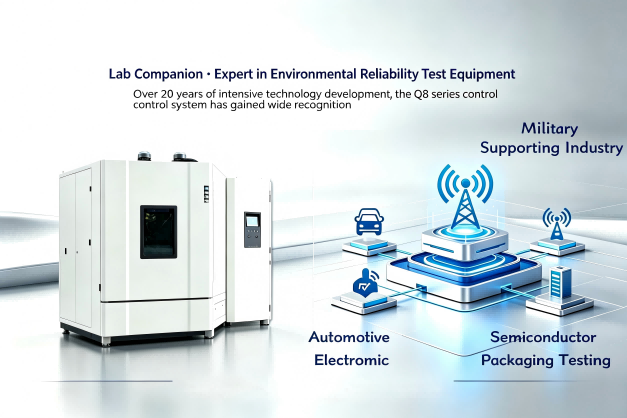
2. Core Advantages of Lab Companion TC-Series Rapid Thermal Change Chambers
Customized for passive and active telecom component validation, all TC-series units hold CE certification for global shipment. The portfolio covers 9 standard chamber volumes ranging from 34L to 1500L, supporting testing for discrete RF chips, compact optical transceivers and integrated small-cell base stations to cover full-scale component and finished-product validation.
2.1 Modular Ramp Rate Configuration to Avoid Over-Engineering
Different 5G components show divergent thermal sensitivity. The TC series supports both linear and non-linear temperature ramp rates from 5°C/min to 25°C/min across five adjustable tiers. Non-linear ramp modes prioritize internal cavity temperature uniformity, ideal for batch screening of passive antenna arrays. Linear ramp modes comply strictly with JEDEC solid-state component specifications, eliminating hidden component damage caused by abrupt temperature shifts for RF baseband chips and high-speed optical modules.
Thanks to modular refrigeration architecture, users can upgrade ramp performance via add-on refrigeration modules without full equipment replacement when testing standards update. For extreme low-temperature scenarios including 5G millimeter-wave component validation, optional liquid nitrogen auxiliary cooling kits are available to break mechanical refrigeration speed limits for automotive and military-grade telecom compliance.
2.2 Ultra-Wide Temperature Range for Global Climate Replication
5G base stations are deployed across Arctic cold zones, arid inland regions, humid coastal areas and high-altitude plateaus, with cross-regional temperature differentials exceeding 100°C. The TC series delivers a core temperature range of -70°C to +150°C, providing ample testing redundancy beyond the -40°C to +85°C standard requirement for mainstream 5G hardware. The matched TH-series combined temperature-humidity chambers offer 20%RH to 98%RH humidity regulation, replicating high-temperature high-humidity conditions for 85°C/85%RH long-term aging tests required for coastal outdoor telecom infrastructure.
2.3 Dual Cascade Refrigeration: High Precision with Low Energy Consumption
Unlike single-stage refrigeration used by generic competitors, TC chambers adopt dual cascade refrigeration loops with environmentally compliant refrigerants: zero-ODP R23 for low-temperature circuits and low-loss R404A for high-temperature circuits. Paired with Copeland and Danfoss hermetic dual-stage compressors, the system cuts energy consumption by 18% under identical thermal ramp conditions. Nickel-chromium alloy heating tubes ensure uniform heat distribution, while dual PID collaborative control eliminates temperature overshoot and drift.
The multilingual touchscreen interface simplifies parameter configuration, with built-in power-off recovery, automatic calibration and scheduled startup functions to support unattended 24/7 lab operation, a core requirement for overseas automated testing labs.
2.4 Cloud-Based Intelligent Monitoring for Traceable Test Data
Powered by Lab Companion proprietary fuzzy PID algorithms, the chambers maintain temperature fluctuation within ±0.5°C and spatial deviation within ±2°C, fully meeting international telecom calibration standards. Local storage retains 5+ years of temperature curves and fault logs with exportable Excel/PDF reports for ISO 17025 and CNAS audit compliance. Built-in Ethernet connectivity enables cloud remote monitoring: global clients can remotely start/stop tests, view real-time thermal data and receive fault alerts via desktop or mobile terminals. The system features 32 automatic fault diagnosis protocols with multilingual troubleshooting prompts to accelerate on-site staff resolution without manual manuals.
3. Global Field Application Cases Across the 5G Supply Chain
3.1 RF Front-End Module R&D Validation
RF front-end modules directly determine 5G signal stability. A global leading massive MIMO antenna supplier adopted Lab Companion TC-100L chambers to conduct -55°C to +125°C rapid thermal cycling and 1000-hour 85°C/85%RH aging tests per YD/T 4110-2022. Uniform cavity thermal conditions identified hidden failures including adhesive delamination and gold-plated connector oxidation before mass production. Post-test verification confirmed frequency error within ±0.04ppm and output power fluctuation below ±2.2dB, meeting global operator access specifications.
3.2 Integrated Small-Cell Base Station Mass Screening
Outdoor small cells face severe diurnal thermal swings in urban and roadside deployments. A Southeast Asian telecom integrator deployed TC-340L chambers for 500+ cycles of -40°C to +70°C thermal shock testing to simulate 5 years of outdoor operating stress. Repeatable high-precision temperature control eliminated early failures of motherboard solder joints and power capacitors, reducing field failure rates from 1.2% to 0.27% for shipped units.
3.3 800G/1.6T High-Speed Optical Transceiver Testing
Laser chips in next-gen optical transceivers show extreme thermal sensitivity, with minor temperature shifts triggering code errors and optical power attenuation. Lab Companion compact TC models are widely used by transceiver manufacturers across Europe and Southeast Asia. Standard 10°C/min linear thermal cycling from -40°C to +85°C verifies extinction ratio, receiver sensitivity and bit error rate stability for cabinet-mounted transceivers operating without active cooling.
4. Overseas Service Framework: Remote-Only Support for Global Clients
Lab Companion does not provide on-site door-to-door maintenance for overseas clients, complying with cross-border logistics and local labor regulatory restrictions. We deliver full-lifecycle remote technical support covering all overseas regions, with standardized global service rules:
• Warranty Coverage: 1-year global comprehensive warranty for labor and standard components; 3-year extended warranty for core components including compressors and main control boards, with lifelong free remote technical consultation.
• In-Warranty Support: Unlimited multilingual remote video guidance for installation, calibration, routine maintenance and fault diagnosis; free digital firmware updates and electronic operation manuals. No on-site dispatch is included in overseas warranty packages.
• Post-Warranty Support: Transparent component pricing with no hidden fees. All spare parts are shipped from overseas bonded warehouses with standardized international logistics lead times.
• Remote Response SLA: 2-hour response window for urgent technical inquiries via email, video call and dedicated customer portal; detailed remote troubleshooting reports delivered within 12 working hours.
5. Future Outlook: 5G-A and 6G-Oriented Testing Innovation
Global telecom networks are transitioning to 5G-A commercial deployment, with 6G millimeter-wave, integrated sensing and communication (ISAC) technology under active R&D. Millimeter-wave antennas will see heat flux exceeding 500W/cm² and wider thermal tolerance ranges, driving demand for combined thermal-vibration environmental testing.
Lab Companion will prioritize two core upgrades for global clients: low-carbon refrigeration optimization to align with EU carbon border adjustment regulations, and combined thermal-shock-vibration testing systems for 6G ISAC hardware. We will continue to deliver high-precision, scalable and low-energy environmental simulation solutions, supporting global telecom manufacturers to improve long-term device reliability across cross-climate deployments.
 Nhận báo giá


 Mạng IPv6 được hỗ trợ